OpenAI Might Be Building Its Own Google Search Console. What Does This Mean for Businesses?
For years, businesses have relied on Google Search Console to understand how their websites perform in search results. How many people see their website? Which search queries bring visitors? How many clicks are they receiving?
It has been one of the most important tools in every SEO professional's toolkit.
But the way people discover businesses is changing.
Today, someone looking for a software solution, a marketing agency or even a business recommendation might not start with Google. They might simply open ChatGPT and ask:
"Which is the best business card scanning app for small businesses?"
Or:
"Can you recommend a reliable AI development company?"
And this raises an important question for businesses: How do you know whether ChatGPT is recommending your brand, mentioning your products or sending potential customers to your website?
Until now, measuring that visibility has largely depended on third-party AI visibility and GEO monitoring tools.
That might be about to change.
OpenAI's New Business Feature: "Claim Your Business in ChatGPT"
On November 6, 2026, screenshots shared by e-commerce analyst Juozas Kaziukėnas revealed what appears to be an unreleased business feature inside ChatGPT.
The interface carries the heading:
"Claim your business in ChatGPT."
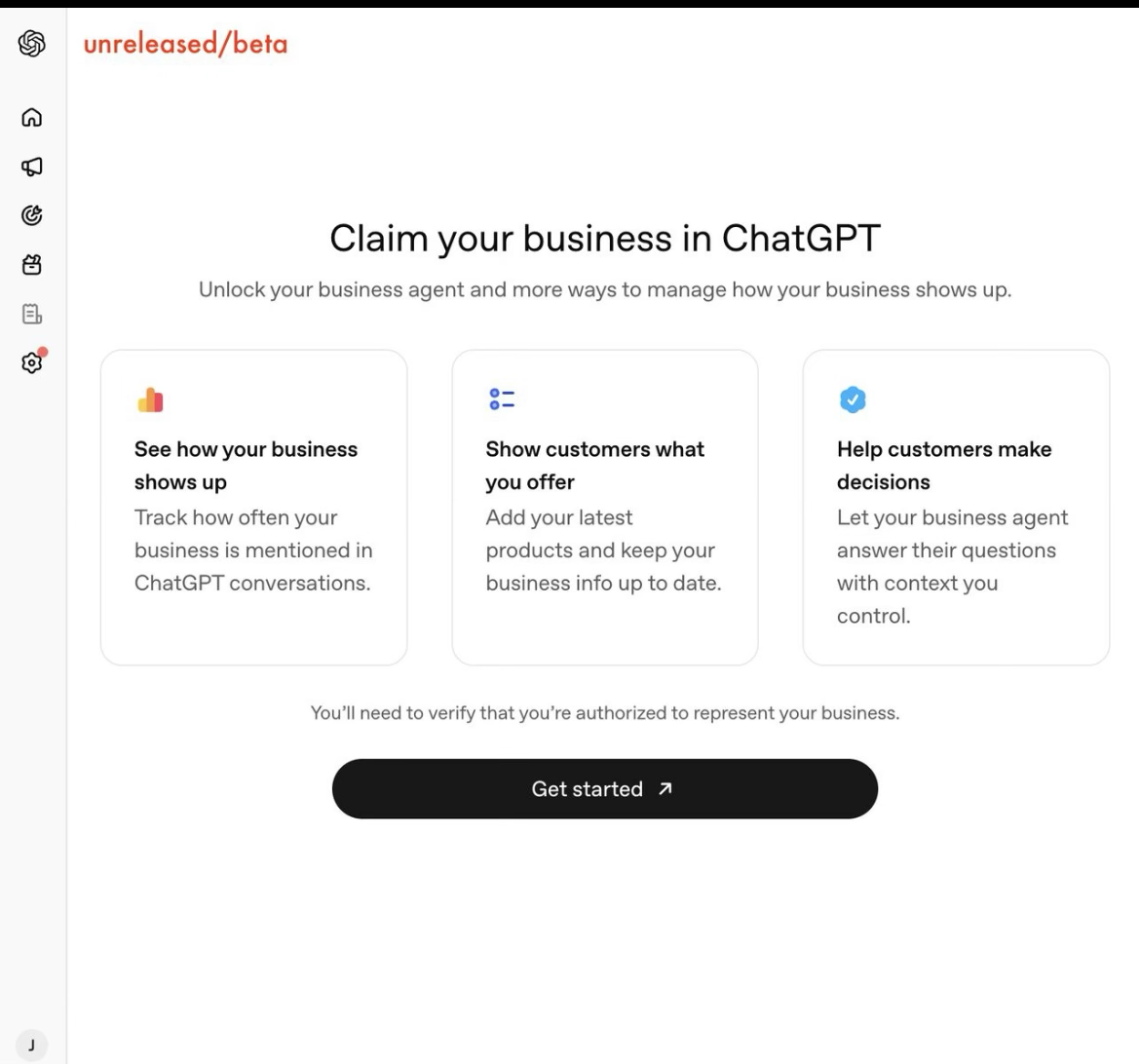
The screenshot also displays an "unreleased/beta" label, suggesting that the feature is still being developed.
According to the screenshot and subsequent industry reporting, OpenAI appears to be working on a business platform that could help companies manage their presence and understand how they appear in ChatGPT conversations.
The interface highlights three major capabilities.
1. Understand How Your Business Appears in ChatGPT
One of the most interesting features is business visibility tracking.
Businesses could potentially see how frequently they appear in ChatGPT conversations and how often users click links leading to their websites.
According to the analyst who discovered the feature, the reported analytics include:
- Impressions: How often a business appears in ChatGPT responses.
- Clicks: How often users click through to its website.
- Daily performance: A chart showing how these numbers change over time.
Think about what this could mean.
A business investing in Generative Engine Optimization (GEO) could eventually have access to first-party performance data from OpenAI itself, rather than depending entirely on estimates from external tools.
2. Manage Your Business Information and Products
The second capability focuses on business information management.
The screenshot says:
"Show customers what you offer."
It also mentions the ability to add the latest products and keep business information up to date.
This could become particularly useful for companies with multiple products, changing product features or frequently updated service offerings.
For example, a SaaS company could maintain updated information about its pricing, product capabilities and available services.
The idea is simple: when customers ask ChatGPT about a business or its products, having accurate and up-to-date information could help provide better context.
However, adding information should not be confused with guaranteeing that ChatGPT will recommend or cite a business.
3. A Business Agent That Helps Customers Make Decisions
The third capability is perhaps the most interesting.
The screenshot mentions:
"Help customers make decisions."
It describes a business agent that can answer customer questions using context controlled by the business.
Imagine a potential customer asking questions about a software product:
- What problems does this product solve?
- Is it suitable for small businesses?
- What features are included?
- How is it different from competing solutions?
A business agent could potentially answer these questions using information supplied and controlled by the company.
If implemented as described, this could create another way for businesses to interact with potential customers through ChatGPT.
Is This OpenAI's Version of Google Search Console?
This is probably the question most SEO professionals are asking.
Google Search Console helps website owners understand their organic search performance through impressions, clicks, search queries and indexing information.
The reported ChatGPT feature appears to be moving in a similar direction, but it is not yet a complete equivalent.
Here is how they compare based on the currently reported information.
| Capability | Google Search Console | Reported ChatGPT feature |
|---|---|---|
| Search visibility | Yes | Business impressions |
| Website clicks | Yes | Reported |
| Daily performance | Yes | Reported |
| Search queries/prompts | Yes | Not reported |
| Keyword rankings | Yes | Not reported |
| Business verification | Search property verification | Business ownership verification |
| Product information management | No equivalent feature | Reported |
| Business agent | No equivalent feature | Reported |
There is one important limitation worth mentioning.
The reported interface does not appear to provide information about the exact prompts that triggered a business mention. It also does not reportedly include competitor benchmarks or user-level data.
That means businesses might be able to understand whether their visibility is increasing or decreasing, but not necessarily why.
Nevertheless, having performance data directly from the platform would be a meaningful step forward.
Why This Matters for SEO and GEO
Traditional SEO has largely focused on helping websites rank in search engine results.
But AI-powered discovery introduces another layer.
A business might have a well-optimised website, strong keyword rankings and good organic traffic, yet still struggle to appear in AI-generated recommendations.
This is where Generative Engine Optimization (GEO) becomes increasingly important.
GEO focuses on improving how brands, products and businesses are understood, represented and referenced by AI-powered platforms.
For marketers, the potential introduction of first-party ChatGPT analytics could help answer several important questions:
Are AI platforms recognising our brand? Businesses could get a better understanding of how frequently they appear in ChatGPT responses.
Are our GEO efforts producing results? If impressions and website clicks increase after content improvements, businesses could use that information as one indicator of progress.
Are potential customers discovering our products through AI? Referral clicks could provide another way to measure traffic originating from ChatGPT.
Are we keeping our business information accurate? A business information management feature could make it easier to maintain consistent product and company details.
Of course, these metrics would complement traditional SEO reporting rather than replace it.
What Should Businesses Do Before This Feature Launches?
Although the feature has not been officially announced by OpenAI, businesses do not need to wait before preparing for the future of AI search.
Here are five practical steps worth considering.
- Make your business information consistent. Ensure your company name, website, services, product descriptions and contact information are accurate across your website and other trusted online platforms.
- Create content that answers real customer questions. Instead of focusing exclusively on keywords, publish useful content that addresses customer problems, compares solutions and explains your products.
- Strengthen your brand's online credibility. Build a trustworthy digital presence through relevant industry publications, customer reviews, case studies, partnerships and authoritative references.
- Make your website easy for AI crawlers to access. Review your robots.txt configuration, server settings and firewall rules. Make sure legitimate search crawlers are not accidentally blocked.
- Start monitoring AI visibility. Use a consistent set of relevant customer questions to evaluate how your business appears across ChatGPT and other AI platforms. Track mentions, citations, recommendations and referral traffic.
The goal should not simply be to appear in an AI answer. It should be to become a credible and relevant source when customers are researching solutions.
What We Still Don't Know
It is important not to get ahead of the announcement.
The screenshots and industry reports provide an interesting look at what OpenAI may be developing, but several details remain unknown:
- When will the feature become publicly available?
- Which businesses will be eligible?
- Will verification be available to all business types?
- Will there be free and paid plans?
- Will OpenAI introduce detailed prompt-level analytics?
- Will businesses be able to understand which website pages are being cited?
Until OpenAI makes an official announcement, these questions remain unanswered.
Final Thoughts: The Next Chapter of Digital Marketing
The introduction of a business visibility dashboard inside ChatGPT could represent an important shift in how companies measure their digital presence.
For a long time, marketers have been optimising websites for search engines and measuring their performance through tools such as Google Search Console and Google Analytics.
Now, AI-powered discovery is becoming another part of the customer journey.
If OpenAI eventually makes these tools publicly available, businesses could gain a more direct way to understand how they are discovered through ChatGPT.
And perhaps the next question for every marketing team will not just be:
"Are we ranking on Google?"
It will also be:
"When someone asks AI for a recommendation in our industry, is our business part of the conversation?"
That is a question businesses should start thinking about today.
Frequently Asked Questions
1. Is OpenAI launching its own Google Search Console?
OpenAI has not officially announced a Google Search Console equivalent. However, an unreleased beta interface called "Claim your business in ChatGPT" was spotted on November 6, 2026, with reported business visibility analytics.
2. What is ChatGPT's Claim Your Business feature?
It is a reported business management feature that could allow companies to verify ownership, monitor how they appear in ChatGPT, update product information and use a business agent.
3. Can businesses track ChatGPT impressions and clicks?
The unreleased interface reportedly includes daily impression and click tracking. Public availability has not been confirmed.
4. Does ChatGPT currently offer prompt-level analytics?
The reported feature does not appear to provide the exact prompts that trigger business mentions. Whether this will change remains unknown.
5. What is GEO and why is it important?
Generative Engine Optimization (GEO) is the practice of improving a brand's visibility and representation across AI-powered answer platforms. It complements traditional SEO by focusing on how AI systems discover, understand and reference businesses.
Editorial note: This article is based on industry reporting and screenshots of an unreleased interface as of November 7, 2026. OpenAI has not officially confirmed the feature, its final functionality or its release date.